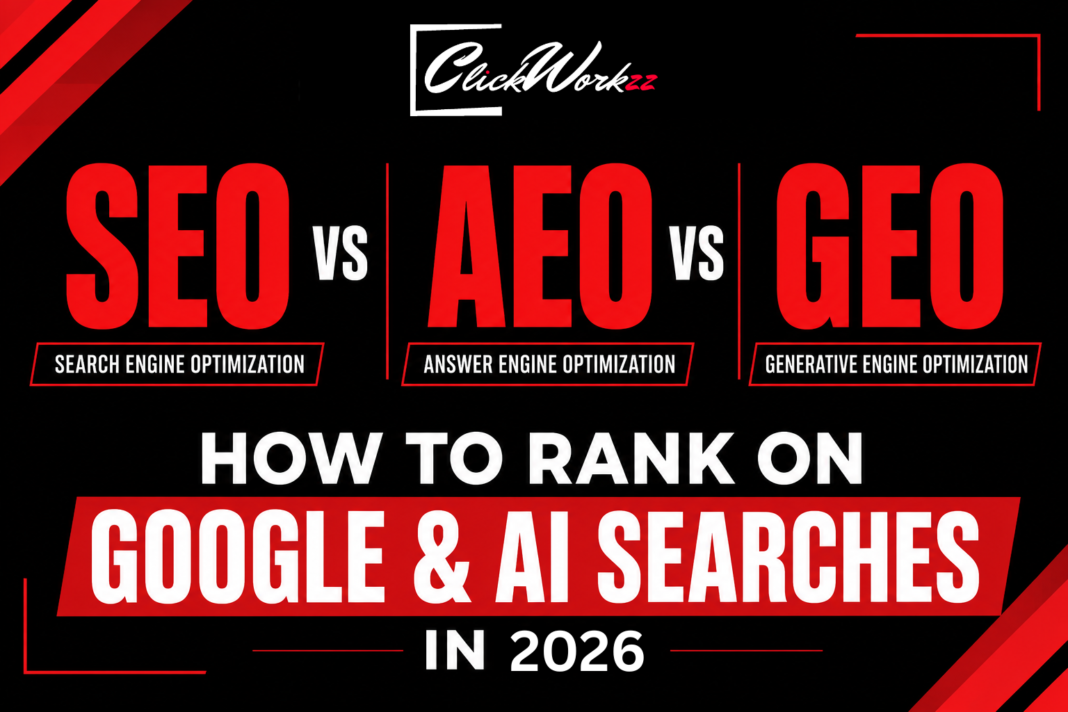

How to Rank on Google & AI Searches in 2025
Introduction: The Evolution of Search
The digital landscape has undergone a seismic shift. For over two decades, SEO (Search Engine Optimization) has been the cornerstone of digital visibility. But in 2025, the game is changing faster than ever before. We’re now navigating a complex ecosystem where AEO (Answer Engine Optimization) and GEO (Geographic SEO) are redefining how content ranks and reaches audiences.
Whether you’re a digital marketer, business owner, or content creator, understanding these three optimization pillars is critical for staying competitive. This comprehensive guide explores the differences between SEO, AEO, and GEO, examines Google’s 25-year journey, and reveals actionable strategies to dominate both traditional search and emerging AI search engines like ChatGPT.
Part 1: Understanding SEO, AEO, and GEO
SEO is the practice of optimizing web content to rank higher on search engine results pages (SERPs), primarily Google. For 25 years, SEO has focused on technical optimization, keyword research, backlink building, and user experience. SEO remains the foundational strategy for driving organic traffic from traditional search engines.
Core SEO Pillars:
- Keyword optimization and research
- On-page and off-page optimization
- Technical SEO (site speed, mobile responsiveness, crawlability)
- Backlink profile and domain authority
- Content quality and relevance
What is AEO (Answer Engine Optimization)?
Answer Engine Optimization is a newer approach designed specifically for AI-powered search engines and conversational AI like ChatGPT, Perplexity AI, and Google Gemini. Rather than optimizing for keyword rankings, AEO focuses on providing direct, concise answers that AI systems will cite or recommend.
Key AEO Strategies:
- Answer-focused content (not keyword-focused)
- FAQ sections that directly address user queries
- Structured data and schema markup
- Fact-based, authoritative information
- Clear, concise writing that AI can extract
- Building topical authority and E-E-A-T (Experience, Expertise, Authoritativeness, Trustworthiness)
What is GEO (Geographic SEO)?
Geographic SEO (or Local SEO) optimizes your content to appear in search results for location-specific queries. It’s crucial for businesses with physical locations or serving specific geographic areas. GEO ensures your business appears in Google Maps, Local Pack results, and location-based searches.
- Key GEO Elements:
- Google My Business optimization
- Local business schema markup
- Location-specific keywords
- Local citations and NAP (Name, Address, Phone) consistency
- Local backlinks and community engagement
- Reviews and ratings management
SEO vs AEO vs GEO: Quick Comparison
| Aspect | SEO | AEO | GEO |
|---|---|---|---|
| Platform | Google, Bing, Yahoo | ChatGPT, Perplexity, Gemini | Google Maps, Local Search |
| Focus | Rankings & Traffic | AI Citations & Answers | Local Visibility |
| Primary Goal | First Page Rankings | AI Recommendation | Map Pack #1-3 |
| Content Strategy | Keyword-rich, comprehensive | Answer-focused, authoritative | Location-specific, community-focused |
| Key Metric | Click-through rate | AI Citation Rate | Local Conversions |
Part 2: Google’s 25-Year Evolution
The Four Eras of Google Search
Era 1: The Keyword Revolution (1998-2004)
When Google launched in 1998, it revolutionized search with PageRank technology. The focus was simple: find web pages containing the keywords users searched for. Success was measured by keyword density and backlink quantity. Content creators stuffed keywords, and search results were often less relevant. This era established SEO as we know it.
Era 2: The Content Quality Shift (2004-2012)
Google introduced the Helpful Content Update framework and Panda algorithm (2011). Google began penalizing low-quality content and prioritizing user experience. This era marked the decline of keyword stuffing and the rise of comprehensive, well-researched content. Content marketing became essential.
Era 3: The AI & Semantic Understanding (2012-2019)
Google’s Hummingbird update (2013) introduced semantic search—understanding the meaning behind queries, not just keywords. RankBrain AI algorithm (2015) began learning from user behavior. Mobile-first indexing (2018) reflected the mobile revolution. This era prioritized user intent and experience.
Era 4: The AI-Driven Future (2019-2025)
Google integrated advanced AI/ML models, introduced BERT for natural language understanding, and launched AI Overviews (formerly called SGE). Core Web Vitals became ranking factors. Google now understands topics holistically. The rise of answer engine optimization reflects this AI-first approach.
Key Insight: Google's evolution shows a clear trend: from keyword matching → content quality → user intent → AI understanding. Success today requires optimization across all three pillars: traditional SEO fundamentals, answer-engine readiness, and if applicable, local optimization.
Part 3: How to Rank on AI Searches Like ChatGPT
Why ChatGPT & AI Searches Matter
ChatGPT and similar AI tools are changing how people search. Rather than clicking through 10 blue links, users ask conversational questions and receive synthesized answers. For businesses, this means visibility on AI platforms is becoming as important as Google rankings.
Here’s the critical question: Will ChatGPT replace Google? No—but it will capture a growing share of information-seeking queries. Brands need to appear in both ecosystems.
8 Strategies to Rank on ChatGPT & AI Searches
1. Create Answer-Focused Content
AI systems prefer direct, concise answers. Instead of “The History of SEO” (too broad), write “What is SEO in 50 words?” or “5 Ways to Improve Your Google Rankings.” Structure content to answer specific questions clearly in the first paragraph.
2. Implement Schema Markup & Structured Data
Use Schema.org markup to help AI systems understand your content. Implement:
- Article schema with author, date, and content
- FAQ schema for question-answer pairs
- Organization schema for brand info
- LocalBusiness schema for location data
3. Build E-E-A-T Signals
E-E-A-T (Experience, Expertise, Authoritativeness, Trustworthiness) is critical for AI ranking. Demonstrate:
- Author credentials and expertise
- Citations from authoritative sources
- Original research and data
- Verified author information
4. Optimize for Conversational Keywords
AI searches favor natural language. Target question-based keywords: “How do I…”, “What is…”, “Why should I…”, “Best way to…” rather than traditional keywords.
5. Create Comprehensive Topic Clusters
AI systems reward content that thoroughly covers a topic from multiple angles. Create pillar content with detailed subtopics linked together, establishing topical authority.
6. Emphasize Original Data & Research
AI systems value original insights. Include:
- Original research and surveys
- Case studies with real results
- Data visualizations and charts
- Unique perspectives and analysis
7. Ensure Content Accessibility & Clarity
AI can read both text and structured data. Use:
- Clear headings (H1, H2, H3)
- Short paragraphs (3-4 sentences max)
- Bullet points for lists
- Descriptive alt text for images
8. Monitor AI Citation Rates
Track where your content appears in AI-generated responses. Tools like SEMrush and Ahrefs are adding AI tracking features. Optimize content that generates citations.
Pro Tip for ChatGPT Ranking:
ChatGPT's training data includes content up to April 2024 (and newer in some cases). To appear in AI recommendations, ensure your content is on a site with strong domain authority, proper indexing, and clear authorship. Focus on becoming a "go-to source" that AI systems trust.
Part 4: Is ChatGPT Valid for Information?
This is a critical question for both users and creators. Is ChatGPT a reliable source? The answer is nuanced:
ChatGPT Strengths:
- Synthesizes information from diverse sources
- Explains complex topics clearly
- Provides balanced perspectives
- Identifies knowledge gaps transparently
ChatGPT Limitations:
- Hallucinations: ChatGPT can confidently state false information
- Outdated Training: Knowledge cutoff means recent events may be missing
- No Real-Time Data: Can’t browse the internet or verify current facts
- Bias: Training data contains human biases
- No Sources by Default: Answers lack citations unless explicitly requested
Recommendation: ChatGPT is excellent for initial research, explanations, and brainstorming, but should always be verified with authoritative primary sources. For businesses, this means: (1) your content must be fact-checked and authoritative, and (2) including clear citations and sources increases AI reliability and your ranking potential.
Part 5: Complete Meta Tags & SEO Setup
Below is the complete meta tag structure used for this article. Customize these for your content:
Essential Meta Tags:
<meta charset="UTF-8">
<meta name="viewport" content="width=device-width, initial-scale=1.0">
<meta name="description" content="[120-160 characters describing your page]">
<meta name="keywords" content="SEO, AEO, GEO, search ranking, Google algorithm">
<meta name="author" content="[Your Name/Brand]">
<meta name="robots" content="index, follow">
Open Graph Tags (Social Sharing):
<meta property="og:title" content="[Your Title]">
<meta property="og:description" content="[Description]">
<meta property="og:image" content="[Image URL]">
<meta property="og:url" content="[Page URL]">
<meta property="og:type" content="article">
Schema Markup (Structured Data):
<script type="application/ld+json">
{
  "@context": "https://schema.org",
  "@type": "BlogPosting",
  "headline": "[Article Title]",
  "author": {"@type": "Person", "name": "[Author]"},
  "datePublished": "2025-06-08",
  "image": "[Image URL]"
}
</script>
Part 6: Action Plan – Implementing SEO, AEO & GEO
Month 1: Foundation & SEO Audit
- Conduct keyword research for your niche
- Audit existing content for SEO compliance
- Implement proper meta tags on all pages
- Set up Google Search Console and Analytics
- Optimize title tags and meta descriptions
Month 2: AEO Optimization
- Rewrite content with answer-first approach
- Add FAQ sections addressing common questions
- Implement schema markup on all pages
- Build topical authority clusters
- Add author credentials and E-E-A-T signals
Month 3: GEO & Technical
- Create/optimize Google My Business listing
- Add local schema markup
- Improve site speed and Core Web Vitals
- Build mobile-responsive design
- Generate local citations