
Google Ads vs Meta Ads ROI 2026: Which Platform Wins?
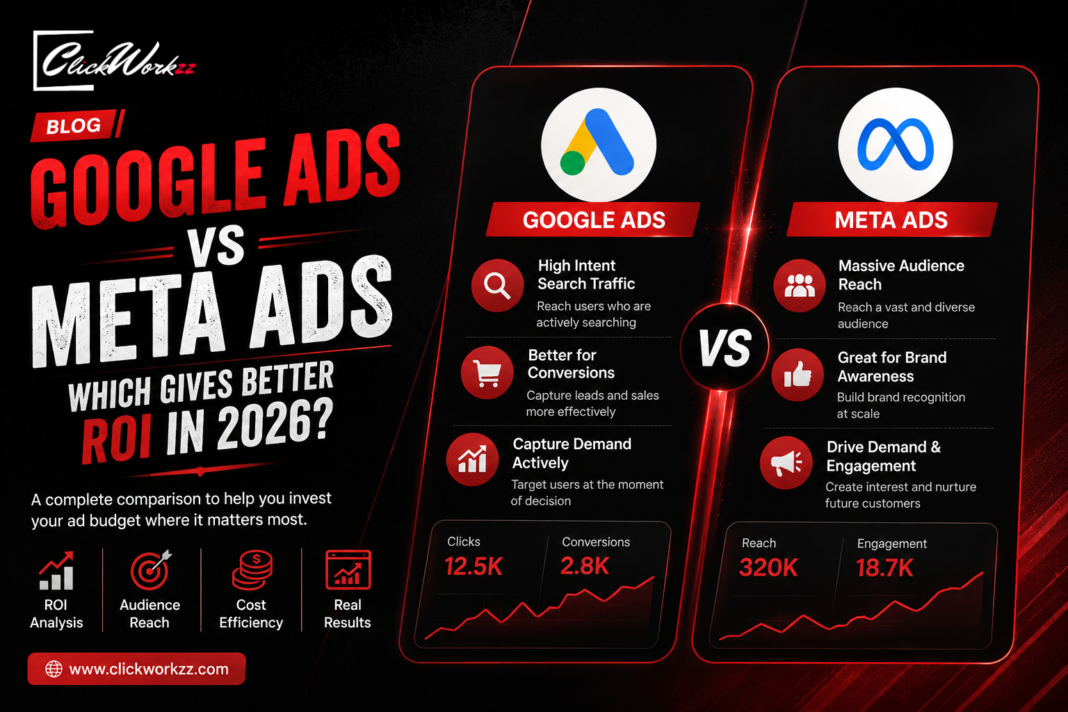
Google Ads vs Meta Ads ROI 2026 comes down to this: Google Ads generally delivers better ROI for high-intent, ready-to-buy customers because it captures existing search demand. Meta Ads generally delivers better ROI for awareness, engagement, and lower-cost demand creation, especially for e-commerce and D2C brands with strong creative. Most profitable businesses in 2026 don’t pick one they run both, with Meta building demand and Google capturing it.
Google Ads vs Meta Ads: 2026 Numbers at a Glance
| Metric | Google Ads | Meta Ads |
|---|---|---|
| Average CPC | ~$4–5 | ~$0.50–1.50 |
| Average conversion rate | ~3.5–3.8% | ~0.9–1% |
| Average ROAS | ~4.2x | ~5.8x (up to 8x for strong e-commerce creative) |
| Best for | High-intent, ready-to-buy traffic | Awareness, discovery, retargeting |
| Buying stage | Bottom-of-funnel (capturing demand) | Top-of-funnel (creating demand) |
These are industry averages pulled from multiple 2026 ad benchmark reports actual results vary heavily by industry, creative quality, and tracking setup.
Why Google Ads Often Wins on Intent
Google Ads works because it meets people at the exact moment they’re searching for a solution. Someone typing “best prosthodontist in Dubai” or “3BHK villa for sale in Pune” already has intent Google just needs to be the answer they click.
This is why Google Ads tends to show:
- Higher conversion rates
- Higher average order value
- Stronger performance in service-based and B2B businesses, where the buyer is actively researching before purchase
In 2026, Google’s AI Max and Performance Max campaigns have made this even stronger by interpreting search intent rather than just matching exact keywords, and by spreading one campaign across Search, Shopping, YouTube, and Display automatically.
Why Meta Ads Often Wins on Cost and Scale
Meta Ads (Facebook and Instagram) works differently it doesn’t wait for demand, it creates it. A scroll-stopping video or carousel can introduce a product to someone who wasn’t looking for it at all.
This is why Meta Ads tends to show:
- Lower cost-per-click
- Higher raw ROAS numbers for e-commerce brands with strong creative
- Better performance for brand awareness, retargeting, and D2C/impulse-purchase categories
The tradeoff: Meta’s ROI often takes longer to show up in the numbers, because a chunk of its value shows up later as branded search on Google commonly called the halo effect.
Google Ads vs Meta Ads: Which One Should You Choose?
| Your goal | Better platform |
|---|---|
| Immediate leads or sales from people already searching | Google Ads |
| Brand awareness and audience growth | Meta Ads |
| E-commerce with strong visual products | Meta Ads (often paired with Google Shopping) |
| B2B / high-ticket services (real estate, healthcare, consulting) | Google Ads, with Meta for retargeting |
| Limited budget, testing a new offer | Meta Ads (lower entry cost) |
| Long sales cycle | Both Meta to build awareness, Google to close |
The 2026 Reality: It’s Not Either/Or
Industry forecasts show Meta and Google are now almost neck-and-neck in global ad spend share, which reflects how advertisers actually use them: together, not as competitors. The most effective 2026 strategy is a full-funnel approach —
- Meta Ads introduces your brand and builds familiarity
- Retargeting (on both platforms) brings back people who showed interest
- Google Search Ads captures them when they’re ready to act
Businesses that split budget this way typically see stronger blended ROI than those relying on a single platform.
How to Actually Measure ROI Correctly
Regardless of platform, track these consistently:
- Customer Acquisition Cost (CAC) – total spend divided by new customers
- Return on Ad Spend (ROAS) – revenue generated per dollar spent
- Conversion rate by funnel stage – not just clicks, but qualified leads and closed sales
- Attribution window – Google and Meta rarely match exactly in analytics because they use different attribution models; focus on consistent measurement rather than forcing the numbers to align
Frequently Asked Questions
Is Google Ads or Meta Ads cheaper in 2026? Meta Ads has a lower average cost-per-click. Google Ads costs more per click but converts at a higher rate, so cost-per-acquisition is the more accurate comparison than CPC alone.
Which platform is better for real estate or healthcare businesses? Google Ads typically performs better for high-ticket, research-heavy purchases like real estate and healthcare, since buyers actively search before deciding. Meta Ads works well alongside it for retargeting and building trust with visual content.
Can I get good ROI using only one platform? Yes, but most brands see stronger blended ROI running both Meta to create demand, Google to capture it.
Which has better ROAS, Google or Meta? Meta Ads often shows a higher headline ROAS in 2026, especially for e-commerce with strong creative. Google Ads tends to show stronger ROI over a longer (30-day) attribution window due to higher-value, higher-intent conversions.
Clickworkzz helps businesses across Dubai and India build full-funnel paid media strategies across Google and Meta backed by AI-driven optimisation and GEO-ready content.