
Every business owner asks one common question:
“Should I invest in organic marketing or paid marketing?”
It is one of the most debated topics in the digital marketing world. Some experts say organic marketing builds long-term value. Others argue that paid marketing delivers faster results.
The truth?
Both strategies work. But in different ways. For different goals. At different times.
In this complete guide, we will break down everything you need to know about organic marketing vs paid marketing so you can make the smartest decision for your business in 2026.
Whether you are a startup with a limited budget or an established brand looking to scale, this guide will help you choose the right strategy.
Let us get started.
What is Organic Marketing?
Organic marketing is the process of attracting customers to your business naturally, without paying directly for placement or visibility.
It is about creating value-driven content, building authority, and earning traffic over time.
Organic Marketing Includes:
- Search Engine Optimization (SEO)
- Content marketing (blogs, articles, guides)
- Social media marketing (unpaid posts)
- Email marketing (newsletter campaigns)
- YouTube videos (non-promoted)
- Podcasts
- Word-of-mouth marketing
- Google Business Profile (Local SEO)
Simple Definition:
Organic marketing = Building an audience and attracting traffic without paying per click or per impression.
According to HubSpot, 61% of marketers say improving SEO and growing their organic presence is their top inbound marketing priority.
Organic marketing takes time to show results but delivers compounding, long-term value.
What is Paid Marketing?
Paid marketing is the process of paying platforms to display your ads to a targeted audience. You pay for visibility, clicks, impressions, or conversions.
It delivers faster results but requires continuous investment.
Paid Marketing Includes:
- Google Ads (Search & Display)
- Meta Ads (Facebook & Instagram Ads)
- YouTube Ads
- LinkedIn Ads
- Twitter/X Ads
- Programmatic Advertising
- Influencer Paid Promotions
- Sponsored Content
Simple Definition:
Paid marketing = Paying to get your business in front of the right audience instantly.
According to Statista, global digital advertising spending is expected to exceed $700 billion by 2025.
Paid marketing gives you speed, targeting, and control. But when you stop spending, the traffic stops too.
Key Differences Between Organic Marketing and Paid Marketing
| Feature | Organic Marketing | Paid Marketing |
|---|---|---|
| Cost | Low (time investment) | High (ad budget required) |
| Speed | Slow (3–12 months) | Fast (instant results) |
| Longevity | Long-term results | Short-term (stops with budget) |
| Trust Factor | High (users trust organic) | Lower (users skip ads) |
| Scalability | Slow to scale | Easy to scale quickly |
| Traffic Type | Earned traffic | Bought traffic |
| ROI Timeline | Long-term ROI | Short-term ROI |
| Competition | Content quality-based | Budget-based |
| Best For | Brand authority, SEO | Quick leads, product launches |
| Targeting | Broad (keyword-based) | Highly targeted |
| Analytics | GA4, Search Console | Ad Manager dashboards |
Benefits of Organic Marketing
1. Cost-Effective in the Long Run
You do not pay per click or per impression. Once you rank on Google or build a social audience, the traffic is essentially free.
A well-written blog post can bring thousands of visitors every month for years without spending a single rupee on ads.
2. Builds Trust and Credibility
Studies show that 70-80% of users ignore paid ads and focus on organic results. When users find your content organically, they trust it more.
Organic presence signals authority.
3. Compounding Results
Organic marketing results compound over time. One great piece of content today can drive traffic for years.
Think of it as planting a tree. It takes time but grows stronger.
4. Better Quality Leads
Organic visitors are often further along in the buying journey. They searched for something specific and found your content. This means higher conversion intent.
5. Supports AI Search Visibility
In 2026, AI tools like ChatGPT, Claude, and Google SGE pull answers from well-structured, authoritative content. Organic marketing content that is well-optimized gets cited in AI search results.
6. Brand Authority Building
Consistently publishing helpful content builds your brand as an industry leader. This is difficult to achieve through ads alone.
Benefits of Paid Marketing
1. Instant Results
Unlike organic marketing which takes months, paid ads can generate traffic and leads within hours of launching a campaign.
For product launches, event promotions, or seasonal campaigns, paid marketing is unmatched.
2. Precise Audience Targeting
Paid platforms allow you to target based on:
- Age
- Location
- Interest
- Behavior
- Device
- Purchase intent
- Lookalike audiences
This level of targeting is not possible with organic marketing.
3. Easy Scalability
When a campaign is performing well, you can scale it by simply increasing the budget. Organic scaling requires creating more content and building more links.
4. Full Control
You control:
- When the ad runs
- Who sees it
- How much you spend
- What it says
You can pause, edit, or stop anytime.
5. Measurable ROI
Paid marketing dashboards give you real-time data on:
- Cost per click (CPC)
- Cost per lead (CPL)
- Return on ad spend (ROAS)
- Conversion rate
According to Google Economic Impact, businesses make an average of $2 for every $1 spent on Google Ads.
6. Remarketing Capabilities
Paid marketing allows you to retarget users who visited your website but did not convert. This is a powerful feature for improving conversion rates.
Disadvantages of Organic Marketing
- Takes 3 to 12 months to show significant results
- Requires consistent content creation effort
- Algorithm updates can impact rankings
- Highly competitive in saturated niches
- Requires technical SEO knowledge
Disadvantages of Paid Marketing
- Expensive, especially in competitive industries
- Traffic stops the moment you stop spending
- Ad fatigue reduces performance over time
- Requires ongoing optimization and budget
- Users trust organic results more than ads
- Rising CPCs across major platforms
Which Strategy Is Right for Your Business?
Choose Organic Marketing If:
- – You have a limited budget
– You are playing a long-term game
– You want to build brand authority
– You are targeting informational or research-based keywords
– You want to rank in AI search (ChatGPT, Google SGE)
– You are a content-first business (blog, media, education)
– You want recurring, compounding traffic
Choose Paid Marketing If:
- – You need immediate leads or sales
– You have a product launch or seasonal offer
– You have a healthy marketing budget
– You want precise audience targeting
– You are in a competitive industry where organic takes too long
– You want to test messaging or offers quickly
– You are running an e-commerce store
The Honest Answer:
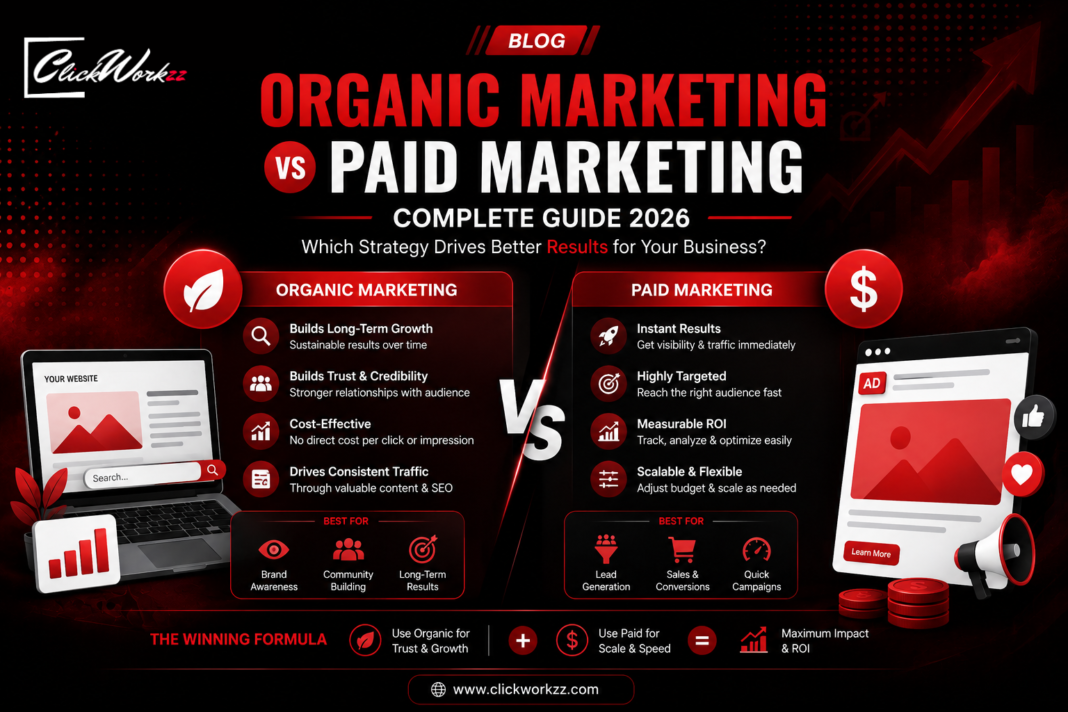
Most successful businesses use BOTH.
Paid marketing drives immediate results while organic marketing builds long-term authority. Together, they create a powerful, sustainable growth engines.
How to Combine Organic and Paid Marketing (The Smart Strategy)
The most successful brands do not choose one over the other. They integrate both into a unified strategy.
Here is how:
Step 1: Use Paid Ads to Test What Works
Run paid campaigns to quickly identify:
- Which messages resonate with your audience
- Which offers convert best
- Which audiences respond most
Step 2: Use Insights to Create Organic Content
Once you know what works in ads, create organic content (blogs, videos, social posts) around those same messages.
Step 3: Use Organic Content to Reduce Ad Costs
When your organic content ranks well, it builds trust and warms up your audience. This means your paid ads convert better, reducing cost per lead.
Step 4: Retarget Organic Visitors with Paid Ads
Use Meta Pixel and Google Tag to track organic visitors. Then retarget them with paid ads to close the sale.
Step 5: Build an Email List from Both Sources
Capture leads from both organic and paid traffic into your email list. Email is the most cost-effective channel for nurturing and converting leads.
Real-World Examples
Example 1: E-Commerce Brand
An e-commerce clothing brand:
- Uses Instagram Ads to drive immediate sales during festivals
- Uses SEO blogs on fashion trends to attract organic traffic year-round
- Uses email marketing to nurture both groups
Result: Paid drives spikes. Organic drives consistency.
Example 2: B2B SaaS Company
A software company:
- Uses Google Ads to capture high-intent buyers
- Uses LinkedIn organic posts to build thought leadership
- Uses blog content to rank for problem-solving keywords
Result: Organic builds trust. Paid closes deals faster.
Example 3: Local Business
A dental clinic:
- Uses Google Business Profile for local organic visibility
- Uses Google Local Ads to appear at the top instantly
- Uses Instagram posts to showcase patient success stories
Result: Combined approach dominates local search.
How to Optimize for Google and AI Search (2026 Strategy)
To rank on Google and get cited in AI tools like ChatGPT, Claude, and Perplexity, your content must:
✅ Answer questions directly – AI tools extract clear, concise answers
✅ Use structured headings (H1, H2, H3) – helps AI parse content
✅ Add FAQ sections – AI loves structured Q&A
✅ Include statistics with sources – makes your content citable
✅ Use tables and comparison formats – AI search loves structured data
✅ Build E-E-A-T (Experience, Expertise, Authoritativeness, Trustworthiness)
✅ Get backlinks from authority sites – signals trust to Google and AI
Q1. What is the main difference between organic and paid marketing?
Organic marketing earns traffic naturally through content, SEO, and social media without paying for clicks. Paid marketing involves paying platforms like Google or Meta to display ads to a targeted audience. Organic is slower but long-lasting. Paid is faster but stops when the budget ends.
Q2. Is organic marketing free?
Organic marketing is not completely free. It requires investment in content creation, SEO tools, and time. However, it does not require paying per click or impression, making it more cost-effective in the long run.
Q3. How long does organic marketing take to show results?
Organic marketing typically takes 3 to 12 months to show significant results, depending on your niche, competition, and consistency of effort.
Q4. Which is better for small businesses, organic or paid marketing?
For small businesses with limited budgets, organic marketing (especially local SEO and content marketing) is a better starting point. As the business grows, integrating paid marketing can accelerate growth.
Q5. Can organic content rank in AI search like ChatGPT or Google SGE?
Yes. Well-structured, authoritative, and data-backed organic content is frequently cited in AI-generated search results. Following AEO (Answer Engine Optimization) best practices helps your content appear in AI answers.
Q6. What is the best combination of organic and paid marketing?
The best strategy is to use paid marketing for immediate traffic and lead generation while simultaneously building organic presence through SEO and content marketing. Over time, organic reduces your dependence on paid ads.
Q8. What is organic marketing in simple terms?
Organic marketing means growing your business by creating useful content, improving your website, and engaging on social media without paying for ads. It is like earning attention rather than buying it.
There is no universal winner in the organic marketing vs paid marketing debate.
Organic marketing is your long-term foundation. It builds trust, authority, and consistent traffic over time.
Paid marketing is your short-term accelerator. It delivers fast results, precise targeting, and immediate visibility.
The most successful businesses in 2026 are those that intelligently combine both strategies, letting paid marketing deliver quick wins while organic marketing builds a sustainable, compounding growth engine.
Start with your goals:
- Need leads now? Start with paid.
- Building for the long term? Invest in organic.
- Want the best of both worlds? Combine them smartly.
Ready to Build Your Digital Marketing Strategy?
Whether you need help with SEO, content marketing, Google Ads, or a complete digital marketing plan, Clickworkzz is here to help.
Visit Clickworkzz to explore our services and get a free consultation today.